
Cost of Ownership
Choosing a bZ4X over a conventional petrol or diesel car not only provides the satisfaction of driving a cutting-edge EV with its quiet and smooth performance, it also offers some real financial benefits; through reduced fuel, tax, and maintenance expenses it is a great choice for both your finances and the planet.
In this section, we’ll explore:

Fuel, tax and service cost savings

Ownership cost comparison

Savings for Company Car/Salary Sacrifice Customers

Savings for Business Owners
Fuel, Tax
& Servicing Savings
The running costs of a bZ4X can be significantly less than an equivalent petrol or diesel car, in terms of fuel costs, road tax (Vehicle Excise Duty) and servicing costs.
Fuel Costs
EVs are generally very efficient and can generally go further than a traditional car on the same amount of energy. This is because their electric motors convert a high percentage of energy stored in their batteries into actual movement, whereas a combustion engine loses a lot of energy to heat and exhaust gases.
Electricity is also generally less expensive than petrol or diesel, which makes the saving on fuel costs even higher.
Where you charge your EV does have an impact on the running costs. Charging at home is the most convenient and cost-effective way.
When charging at a public charging station, the costs can vary, just like at petrol stations. The cost varies depending on location and power/speed of the charger. This is similar to fuelling up at a petrol station on the motorway, compared with one at a supermarket.
How much can you save?
- Our study shows that over a year, you can save up to £749 in fuel if you charge your car at home 80% of the time, and at public chargers 20% of the time (source: Toyota.co.uk)
- On average, the ‘fuel cost per mile’ for a bZ4X (charged at home) is less than half that of a petrol car.
- The cost of charging an EV on the public network is roughly equivalent to fuelling a petrol car, so the cost savings available apply mostly when charging at home.
1 https://www.ofgem.gov.uk/information-consumers/energy-advice-households/check-if-energy-price-cap-affects-you.
Public Charging: www.zap-map.com/charge-points/public-charging-point-networks (sources accessed 15/11/2023.) and the pence per litre cost of standard unleaded petrol on 15/11/2023 as stated by the RAC – https://www.rac.co.uk/drive/advice/fuel-watch/
2 www.gov.uk/government/publications/electric-vehicles-costs-charging-and-infrastructure/electric-vehicles-costs-charging-and-infrastructure
3 www.gov.uk/government/publications/electric-vehicles-costs-charging-and-infrastructure/electric-vehicles-costs-charging-and-infrastructure
Road Tax
As an incentive for people to make the switch to EVs, the government currently allows EVs with zero emissions (CO2 g/km) to be exempt from road tax. They are also exempt from the ‘Expensive Car Supplement’ for cars over £40,000.
There is another benefit too – all EVs are exempt from clean air zone charges such as ULEZ until 25/12/2025.
Servicing / Maintenance
Electric vehicles typically have fewer moving parts and simplified drivetrains compared to traditional petrol/diesel vehicles. Consequently, the maintenance requirements for the bZ4X are generally lower, translating to reduced servicing costs over the vehicle’s lifespan.
The bZ4X has a regenerative braking system that helps to prolong the life of brake pads and discs, further contributing to maintenance savings.
At present, not including any service plan, the saving for a bZ4X over an equivalent Toyota petrol Hybrid (RAV4) is around £125 a year.
Savings that add up
Overall, the combination of higher efficiency, lower electricity prices, potential off-peak charging discounts, government incentives and lower servicing costs, makes electric vehicles more cost-effective.
Toyota Ownership Cost
Comparison Tool
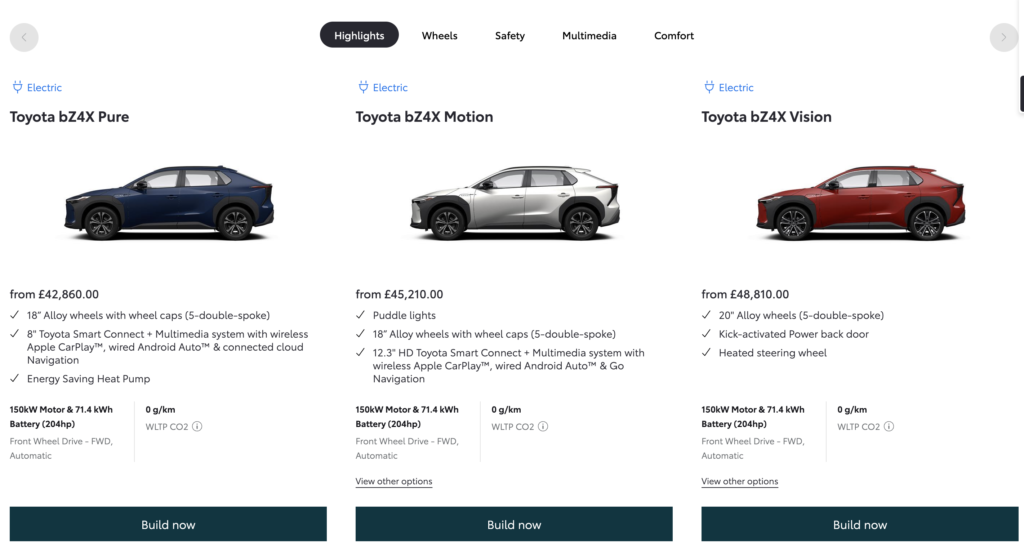
We have a great tool on our website that allows you to compare the fuel and road tax costs of the different grades of bZ4X, against all other Toyota models.
Tax Savings for Company Car & Salary Sacrifice Customers
Driving a bZ4X is extremely efficient when it comes to benefit in kind. Choose the Toyota bZ4X as your company car, and pay as little as £15 per month in benefit in kind (for a 20% tax rate payer) ~ in the 2024/25 tax year.
Powertrain
EV
PHEV(1-50g/km)
Petrol/Diesel
BIK %
2%
~8%
~31%
(exact BIK rate depends on electric range and CO2 emissions)
The government is encouraging company car drivers and those using salary sacrifice schemes to make the switch to an electric vehicle, by offering low Benefit in Kind tax rates.
For EVs or cars with zero CO2 emissions, the tax rate is just 2%. Compared with a petrol/diesel vehicle this could save the customer hundreds of pounds a month in taxation, on top of the fuel cost savings outlined above!
Benefit in Kind for Plug-in Hybrids (PHEVs) is approximately 8%, depending on the CO2 emissions and electric range they can achieve. For all other petrol/diesel cars, the rate can vary between 15% and 37%, depending on CO2 emissions.
You can easily discover the exact monthly Benefit in Kind cost here.
Tax Savings for Business Customers:
When buying a bZ4X, businesses can reduce how much tax they owe on their profits by a substantial amount, which can make a very attractive saving.
CO2 Emissions
(g/km of CO2)
0
1-50g/km
Over 50g/km
Write Down
Allowance 2024/25
100% (First Year)
18%
6%
Business Purchase
When a business buys a car, from a tax perspective it is an ‘expense’ for the business. The government therefore allows businesses to deduct a percentage of the car’s purchase price from their taxable profits, therefore reducing the tax they owe. This is called ‘writing down’ allowance.The percentage they can deduct is based on the car’s CO2 emissions.
For 2024/25, this allowance is 100% of the purchase price for EVs and 18% for PHEVs. This could save the business thousands of pounds that would otherwise be charged in tax. For all other cars, the percentage rate is just 6%.
Business Lease
For a company leasing a EV, 100% of the monthly rental amount and any initial rentals that have been paid can be ‘written off’ as an expense against taxable profits. The 100% first year reduction does not apply for leasing, as the business does not own the car as an asset.
In addition to the tax savings available, companies can benefit from reduced fuel and servicing/maintenance costs.
Choosing an electric car for your business is a great thing to do for the environment, and it looks good on your business.