
Charging
How you ‘fuel’ your car is perhaps the biggest change when switching to an EV. The great news is that charging is actually very simple and easily accessible.
When charging an EV, there is some new terminology to understand; for example, the different plug types, known as ‘CCS’ and ‘Type 2’, and different charger types. Chargers can supply either AC or DC power, and are categorised as ‘Slow’ or ‘Fast’ (AC) or ‘Rapid’ and ‘Ultra-Rapid’ (DC).
EV charging is available in many different places – at home, in shopping centres, at petrol stations and even restaurants, so once you understand how charging works, you can see just how easily it fits with your lifestyle. The convenience of home charging for example, can be one of the best things about owning an EV!
In this section, we’ll explore:

Charging terminology – what do the terms mean?

Charging locations – charging at home and ‘on the road’

Charging times – how long does it take?

Costs of charging – what’s the cost of a charge?
Charging Terminology
- kW = kilowatts – are a measurement of power. They are used to describe the power a charger can provide, or how powerful an EV is, similar to horsepower (in fact, 1 kilowatt = 1.36 horsepower)
- kWh = kilowatt-hours – can be thought of as a unit of energy. A kilowatt-hour is the amount of energy it takes to run a 1,000-watt appliance for an hour. Your electricity supplier already uses kilowatt hours to measure how much energy you use at home. For EVs, it is the equivalent to litres in a fuel tank.
- AC = Alternating Current – a type of power used to charge your car. AC is what your home sockets provide, and is used for ‘Slow’ and ‘Fast’ charging’
- DC = Direct Current – another type of power which is able to charge the car faster. This kind of power is used for ‘Rapid’ and ‘Ultra-Rapid’ charging and is available at public charging stations.
- Type 2 / ‘Mennekes’ – a type of plug used for charging on AC power. Invented by the Mennekes company.
- CCS = ‘Combined Charging System’ – a type of plug that combines an AC ‘Type 2’ or ‘Mennekes’ plug with an additional plug used for DC charging.
- On-Board Charger – Batteries can only store DC (direct current). EVs have on-board chargers which convert the power from an AC source to DC, for storing in the battery. They have a rating of how many kW they can convert in an hour (eg. 11kW).
Charging Locations
The great thing about charging an EV is that it can be done at home, or at any public charge station ‘on the road’:
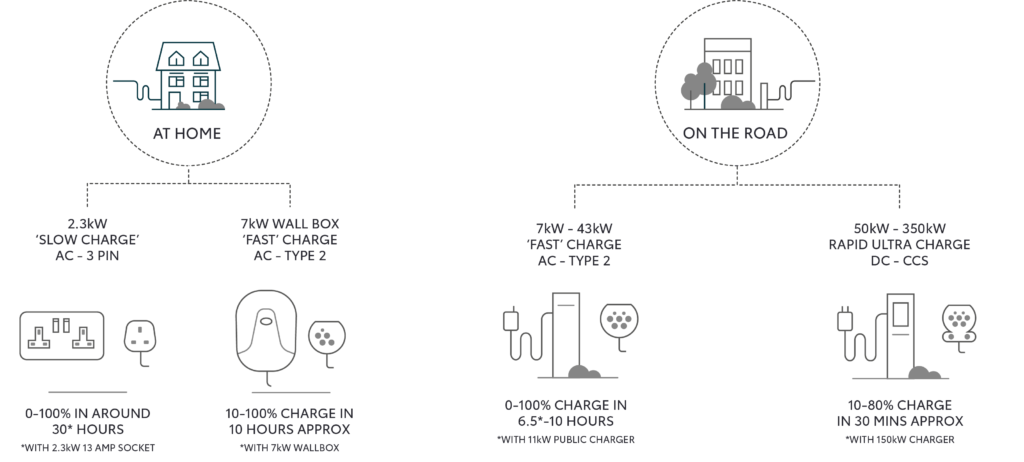

Options for charging at home
Over 80% of EV charging currently takes place at home (source: Energy Saving Trust) as it is the most convenient and cost effective way to charge.
3-pin domestic socket: You can charge an EV using a normal 3-pin socket in your house. This option takes longer to fill the battery, but depending on how much you use your car, it may be all you need.
Home Wallbox: Installing a home wallbox really is a great option and we encourage every EV owner to do so. A wallbox enables ‘fast’ charging at home, meaning you can fully charge a bZ4X from 0-100% in around 10 hours. You just need off-road parking at home to have one installed.
Toyota offers a branded wallbox option – HomeCharge. Designed for ease of use it delivers quality and reliability, just like our cars. It is the only charger designed to work in complete unison with your vehicle and the MyToyota App for a seamless customer experience. Installation is all taken care of too, by our partner British Gas.
Home Charging with the MyToyota App: Toyota’s wallbox integrates perfectly with the MyToyota app. When charging at home, you can benefit from both ‘charge scheduling’ and ‘pre-conditioning’.
Find out more about our HomeCharge WallboxCharge scheduling helps you to save even more on charging costs, by scheduling your charge for when your electricity tariff is cheapest. With an ‘EV tariff’ it can cost less than £5 to completely charge your bZ4X overnight!
‘Pre-conditioning’ your car before you travel is another great perk. This means your car will be ready at the perfect temperature for you at the time you want to start your journey! Perfect for cold mornings!
Public Charging
As of May 2024, there are over 62,500 public charge stations across 33,000 different locations in the UK. That’s over 45% more than there were in May 2023. The number of chargers available to motorists is growing quickly, with over 1300 added in May 2024 (source: Zapmap). You can view the latest stats here.
For comparison, there are 8,353 petrol stations in the UK (source: statista)
Charger Choice:
In the public charging network, you’ll find a vast choice of chargers, with different power levels/speeds. You’ll find ‘AC’ chargers capable of ‘Slow’ and ‘Fast’ charging, which you might use whilst shopping or going to the cinema, for example.
You’ll also find DC chargers at many public charge stations. These are very powerful and offer ‘Rapid’ and ‘Ultra-Rapid’ charging that can charge the bZ4X battery from 10%-80% in just 30 minutes! These are often found around motorways, A-roads and in larger cities and are great to use whilst on a long journey.
Easy to find: With apps like Zapmap, or the Toyota Charging Network (available through the MyToyota app) you can easily find all the charging stations at your location, on your route or at a destination. It’s easy to plan a journey, and you can see all the chargers, their availability, their power ratings and pricing in advance.
Zapmap: A popular and handy charging app.
Click here to find out moreToyota Charging Network: A subscription service providing both convenience and discounted public charging rates.
Click here to find out moreCharging Times
The time it takes to charge can vary depending on:
- The power/speed of the charger you have plugged into
- How full the battery already is (the emptier it is, the quicker the rate of charge)
- The ambient temperature, which mostly affects ‘DC’ charging
It’s really easy to estimate the charge times at different chargers and to see the effect of temperature using our handy online Charge Time Calculator.
Click here to find out moreThis is also a great tool to help you understand how charging can fit in with your lifestyle and the charging options available to you.
Costs of Charging
Just like fuelling a petrol or diesel car, the costs of ‘fuelling’ an EV can differ too, depending on where you choose to charge.
We’ve already mentioned that charging at home is the most convenient and cost-effective way. But just how much does a home charge cost?
Home Charging Cost Example:
To work out the cost of a full charge, from empty to full, we just need to know the price of electricity and the bZ4X’s useable battery capacity, which is 64kWh.
Think of this 64kWh figure as equivalent to the size of the fuel tank in a petrol car.
Currently (July 2024), the average cost of electricity at home is £0.22p per kWh (kilowatt-hour).
Many energy suppliers now offer excellent ‘EV Driver’ tariffs, allowing you to charge overnight for as little as 7p/kWh! This is just one example of how you can make significant savings by choosing an EV, over a petrol or diesel car.
Here’s an example of the cost of charging a bZ4X at home:
(Remember, to charge the bZ4X’s useable battery from empty to full, 0-100%, takes 64kWh of electricity).
‘Standard’ electricity tariff, at home = £0.22p x 64kWh (0-100%) = £14.08p
Overnight ‘EV Driver’ tariff example = £0.07p x 64kWh (0-100%) = £4.48
This is much less than the cost of filling up a petrol or diesel car, and on average you can reduce your fuel costs by 50% by choosing an EV.
To understand the whole picture, we can compare the cost per mile of the bZ4X, against that of an average petrol or diesel car. See our ‘cost of ownership’ section for more information.
Public Charging Cost Example:
The cost of charging at public charge points varies depending on the charge point provider. They set the price depending on the location of the charger and also the amount of power/speed the charge point provides. Those in popular areas often cost a little more. You can easily see the pricing in advance and choose which station to use, via the Zapmap app or the Toyota Charging Network.
When charging in public, you could choose an AC (fast) charger or a DC (rapid or ultra-rapid) charger, depending on how quickly you wish to charge and how much you wish to pay.
In May 2024, the average cost of charging in public was:
AC charger (slow/fast)= 56p/kWh.
DC charger (rapid/ultra-rapid) = 81p/kWh
(source: Zapmap)
Below are some examples of the cost of charging a bZ4X at a public charge point. In this case, we’ve chosen to charge the battery from 10% to 80% full (44.8 kWh in total):
7kW ‘Fast’ AC Charger:
£0.56p x 44.8 kWh = £25.08
150kW ‘Rapid’ DC Charger:
£0.81 x 44.8kWh = £36.29
Toyota Charging Network
The Toyota Charging Network is the ideal tool to help you charge in public. Members have access to over 27,000 charge points across the UK, and 664,626 across Europe. There is a free membership option for those who only charge occasionally in public and a paid subscription that offers up to 20% discount on standard charge point pricing – ideal for those who regularly charge in public. With the Toyota Charging Network, you can conveniently navigate to, unlock and pay for your charge all via the app on your mobile phone.
Be sure to check out our COST OF OWNERSHIP section to see the full cost saving benefits of owning an EV.